Wednesday, June 15, 2016

The Daugherty Visible Typewriter

I was going to do a post titled The Daugherty Disassembled, but this thing cleaned up so fast and so well that I ended up already finishing it by today. 

The Daugherty cleaned up incredibly well, and it turns out that this thing was nickel plated wherever they could fit nickel plating. The quality of the machine is excellent, especially for the time in which it was produced, and its one of the most elegantly simple designs I have ever seen. Dont try to type too fast on it, and youll do alright.

This machine is now one of the crowning glories of my collection, and thats due in large part to its very unique appearance which I love.

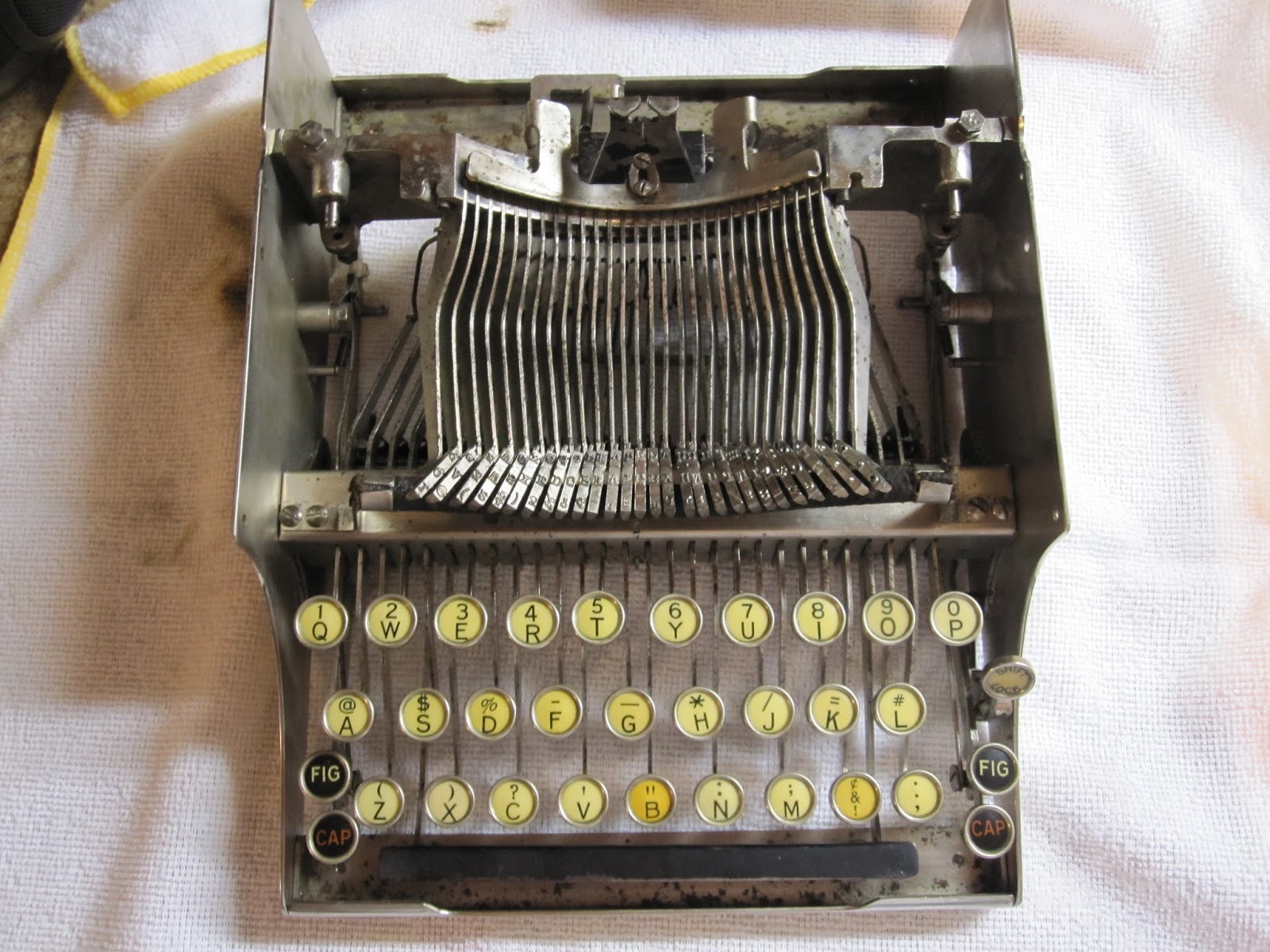
Just check out that frame.


The typebasket plus keylevers comes out after taking out 2 screws, and from there you can take out the two segment rods (if it was a segment machine; I'm not even going to try and make a new name) for the levers, and they fall on out. Made it quick and easy to clean.

Heres the typebasket sans keylevers.


I had cleaned up the main body yesterday, and went ahead and just finished the rest today; that included the most simple carriage I have ever laid eyes upon.


All those bits you see? Thats pretty much all the parts to the carriage. A very efficient design, though it (of course) lacks a lot of features found on the shortly-thereafter-released Underwood.

And here is the machine, all cleaned up. My camera skills may be lacking, but trust me when I say the nickel plated spools are beautiful. Every machine needs 'em.

Before:


After:


Before:


After:


Before:


After:


Now, I just have to cut a ribbon to size. These guys take a ribbon just slightly smaller than the usual half inch, so I'll spend a few minutes tomorrow getting enough ribbon cut to start typing. I'll be ordering some authentic blue ribbon from Baco to make this machine complete.

The only part that I can tell that is missing is a carriage margin. You can see the left one still in place, but somewhere along the line the right one got lost.

Random last notes! The pressure on the universal bar can be adjusted by simply turning a knob on the back, the clockwork motor can be wound up and wound down ridiculously easy compared to literally every other machine ever, and you actually have to engage a small lever above the carriage return to allow the platen to be rotated backwards.

Is there anything anyone wants to know about this machine?

Monday, June 13, 2016

And on the 13th day of June, heavenly light bathed my workstation


A ghostly figure drifted down from the sky, basking in rays of heavenly light. It was the spirit of Christopher Latham Sholes, and as the representative of all typewriter souls, he lifted a solemn finger and pointed to Craigslist.

Obeying the kind spirit, I glanced over at the newly created ad, and heard the choir of angels sing. Understanding my purpose, I made the phonecall, dove into my car, and was where I needed to be; less than 2 miles from my humble home, and within an hour had returned with the prize.

Thanking Mr. Sholes as he drifted away, I sat in disbelief at what I had before me.


The Fritz - Eldridge Expert Typewriting Instruction Book! Oh wait no, behind that.


A metal case with paint loss and broken leather handles! Oh wait, no, under that.


OMIGOSH I CAN SEE IT!!!


AUTHENTIC FADED RIBBON!!! THE MOST VALUED PRIZE OF ALL!!!


Oh, and the Daugherty Visible Typewriter. I guess. If that's your thing. Ribbon's worth like, 999X more.


In reality, though I ended up owning 2 Fox Sterlings of which they only  made 1,000, and a few other slightly rare machines, I actually considered a Daugherty/Pittsburg out of my abilities to acquire. And had you told me that I would end up finding one only a couple miles from home, and for a very affordable price, I would have called you insane. But here we have a Daugherty, found in the wilds of Northern Idaho.


I don't know truly all that much about these puppies, but I do know that they were one of the first visible machines, produced in the 1890's, and had interchangable typebaskets. Hell of a feature, that.


Talking to the owner, I found that it had been purchased brand new by her great-great-grandfather way back when, who happened to be a furniture builder and salesman combo. I suppose this machine would have thus been used for business correspondence or the like, which makes sense.


As is true of almost every machine found up here, there is pretty much no rust. Huzah for lack of year-round humidity.


Its actually still working fine, though it needs a good cleaning and oiling to get into proper shape. Even then, I hear these things can get a bit wonky with their type alignment.


The National 5 which I just repaired only had the spot of "simplest machine" for a few weeks. This Daugherty takes the proverbial cake in its simplicity.


The carriage came off after only taking the carriage string off. Whats with old papers being around the platen?


Keyboard came out after taking out just 2 screws.


Sorry, Fox Portable No. 2 which I promised to work on this week. You're being postponed a few days.

Friday, June 3, 2016

The National No. 5: Back up to snuff


This machine is, by far, the most cheaply made typewriter I have thus far rebuilt. Thats not to say its a bad machine, however. It's simply just not of the higher quality that is found in typewriters like the Fox or Royal. 

And its hilarious how I always miss those few small things when I'm cleaning the machine, and only realize whats missing until I try to type. Case in point: Where the heck are the paper fingers? Why  would they skimp on something so simple, yet helpful? I have to imagine this thing cost an absurdly small amount of money to produce, and at a $40 or $50 price point, youre talking some serious profit. But we cant be spending 2 cents on paper fingers or a paper bail, nosiree.

Regardless, here is the great nickely beast, all shiny and cleaned up. And does it type? Why yes, it does. But not nearly as well as one would hope. The type is misaligned, the impression is poor, and the line spacing is wonky due to a weak spring. In other words, perfect for ransom notes.


And because I could, I made a video. If you want to waste 5 minutes of your life, by all means check it out. I just blabber on about random things regarding the machine.

https://www.youtube.com/watch?v=1CM8C3256Nc


Wednesday, June 1, 2016

The National No. 5: Scrubbing away the grime


Work on the nickel-plated National No. 5 has so far gone swimmingly, with a major improvement cosmetically. As I am terrible with before/after pictures, it may be hard to tell that most of everything was covered in grease, dirt, sludge and corrosion before I got to work. This machine was ridiculously filthy. Taking it apart down to each individual piece for cleaning remedied that, of course.

 Before:


The typebars were completely covered in tar or something, and were all black. Hard to see here, but you can kind of notice it on the far right typebar.


After:

This machine has been quite nice to deal with. 90% of all screws are the same size, which must have saved a tonne of money in regards to production costs. Alongside such, its a very simple yet efficient design. I think it'll work well when its all said and done.

The key tops, as always, cleaned up quite nicely.


And sitting on the workbench now is the carriage, torn asunder.


Tuesday, May 17, 2016

Blinded By The Reflected Light: A National No. 5

 It's never the machines you're actively looking for that you get lucky with. I've yet to find the illusive Fox portable serial number 001, after all. But, just like I accidentally stumbled into possession of a Blickensderfer 9, I accidentally found this National No. 5 just about 3 minutes after it was posted to that notorious bidding site we all know.

 It's hard to properly create a "most-wanted" list, but one of these in full nickel plating was certainly high up there for me. And aside from needing a good restoration, its only missing a platen knob and its case (as far as I can tell anyway).

I've long since learned that the machines I appreciate the most are often the ones that require my services the most. When all I have to do is lightly blow on a machine and its good to go, I don't get invested into it. I don't understand it. And I certainly don't have any attachment to it. But those machines that I take apart down to the last screw, and rebuild, are the ones I genuinely desire to keep. Because I've dedicated myself to it. Learned how every function works. What quirks it has, how well engineered it was. I learn it as a brother.

Enough babbling on though, here is the newest find which I am quite excited about;


It's beautiful. Pitted, of course, but thats fine. Its around a century old, and hasnt had a case for probably decades. I used some steel wool on the right side on the top of the front frame, and its already looking promising (you can see in the picture just above). I'll be grabbing some Mother's Mag and Aluminum Polish to get this puppy to shine in the end.

But, if you know me, you know that no machine is safe. Once it was unpacked, I began my customary exploration and associated dissassembly. The front plate was held in by 4 screws, two on each side, and the back plate had 4 as well;


I already knew it was going to be a simple machine, but by golly is this wonderfully simple.


I have to imagine a repairman would have appreciated the instant, easy access to the mechanism. The actual escapement pivot isn't in the machine (having fallen out previously, and placed in a baggy by the outstanding seller), but otherwise this is it. The bell resides on the back plate.


It took a few seconds of careful study to realize the carriage is held on by only 6 screws, 3 on each side. I had but one thing to do upon realizing such;


I went ahead and took the tension off the motor, since I plan to dissassemble the whole carriage for cleaning at some point.


I love these earlier machines for how easy they are to deal with. Later machines get ridiculously complex sometimes.


Curious as to how well the keys would clean up, I worked on Q for a few seconds. These plastic topped keys always clean up nicely.


I know I say it about every machine, but I think this will be a fun little machine to type on. I love the nickel plating all over, and its got a decent action that reminds me of the Corona 3.

The only issue is that its a three-bank design, and though I absolutely love  three-bank machines, they were almost all designed by the bloody devil. Curse you, shift-necessary period! 


Oh, and I found this little guy at the store I had found that other Olympia SM3. It took me about a second to notice the price tag of $25, another second to check inside the case and find a flawlessly clean SM4, yet one more second to slam the case closed and book it to the front, slam the money down on the counter, and run like a madman out the door.