---William Ross Fox---
William
Ross Fox was born 1853 in Middletown, Connecticut. When he was 9 years old, his
father died, leaving him only his sister and mother as his two older brothers
were enlisted in the United States army in the American Civil War. As a young
boy, Fox began to learn the art of business by peddling Root Beer produced by
his mother at a small country store they owned. As he grew, he took on more
responsibilities of managing and running the store. However, he was intrigued
greatly by machinery, and from the age of 16 to 21, he worked in tool making,
machine tending, and steam engineering.
At the age of 21, he
desired entrance into the Technological Institute of Worcester, Massachusetts,
but was required to pass examinations in algebra and grammar, along with a slew
of other topics, which he knew little about. However, spending his free time
wisely and studying hard during his evenings, he was able to pass said
examinations and enroll at the institution. During his education, he contracted
typhoid-pneumonia, and only just barely survived, the ordeal ending his
educational prospects. He then went to work at the American Threat Co., at
Willmette, Connecticut.
While there, he married,
and through his marriage indirectly created his first invention. Through
helping his wife create frames for mottos, he was forced to use a poorly made miter
box, which his mechanical mind despised. It was thus that he set about making a
more perfect design, and created the Fox trimmer, which would eventually gain
immense success in the business market. Over the course of the next two years,
Mr. Fox perfected his trimmer, invented a rotary steam pump, and designed a
steam chime whistle which also became widely used.

It was in the fall of
1879, however, that Mr. Fox chose to go west and ended up in Grand Rapids,
Michigan, leaving his family behind. He gained employment as a draftsman and
pattern-maker in the factory of Perkins and Co, all the while making
arrangements with a manufacturer in the East to make his trimmer and sell it on
a royalty basis. After two years with Perkins and Co., Mr. Fox switched over to
the Michigan Tool Works, and afterwards the Farmers Roller Mill Co., all the
while gaining valuable knowledge about machinery. While employed by FRM Co, Mr.
Fox made improvements in roller-mill machinery that some of the largest
manufactures in the field had been trying to create for years. By this time, he
obtained the use of water power and machinery in the factory where he was
employed and built a few trimmers, which he sold by correspondence.
He next went to work for
the Berkey and Gay Furniture Company, and invented the Fox furniture caster. In
1886, he sold his half-interest in the caster to the company for 18 months’
rent of a few square feet of floor space, where he began active work on the
manufacture of his trimmer. His capital at this time consisted of $1,545.48,
$800 of which was in cash and second hand tools. This was the beginning of the
Fox Machine Co. As the company grew, Mr. Fox superintended the work, designed
the machinery, made the tools, sold the product, kept the books, attended the correspondence,
wrote the advertisements, and planned the extensions.
The venture proved such a
success that after only two years, a two story brick building was built for it
specifically, which was eventually raised to four stories. In these new
quarters, the enterprise grew at an accelerated pace, so that when it was
incorporated in 1890, the tangible assets were at $75,000.
When, in 1893, the bicycle
became a big hit, the Fox Machine Company began the manufacture of high grade
wheels. Finding the initial work unsatisfactory, Mr. Fox worked on improving
the machines which made the wheels, and soon other bicycle makers demanded Mr. Fox’s
far improved machines to make their own parts. The bicycle craze soon ended,
however, and so Mr. Fox was left with very special machinery for fine work, and
nothing to use it for. It was then that Mr. Fox, ever resourceful, looked
towards the typewriter market and decided that with his equipment, he could
manufacture typewriters.

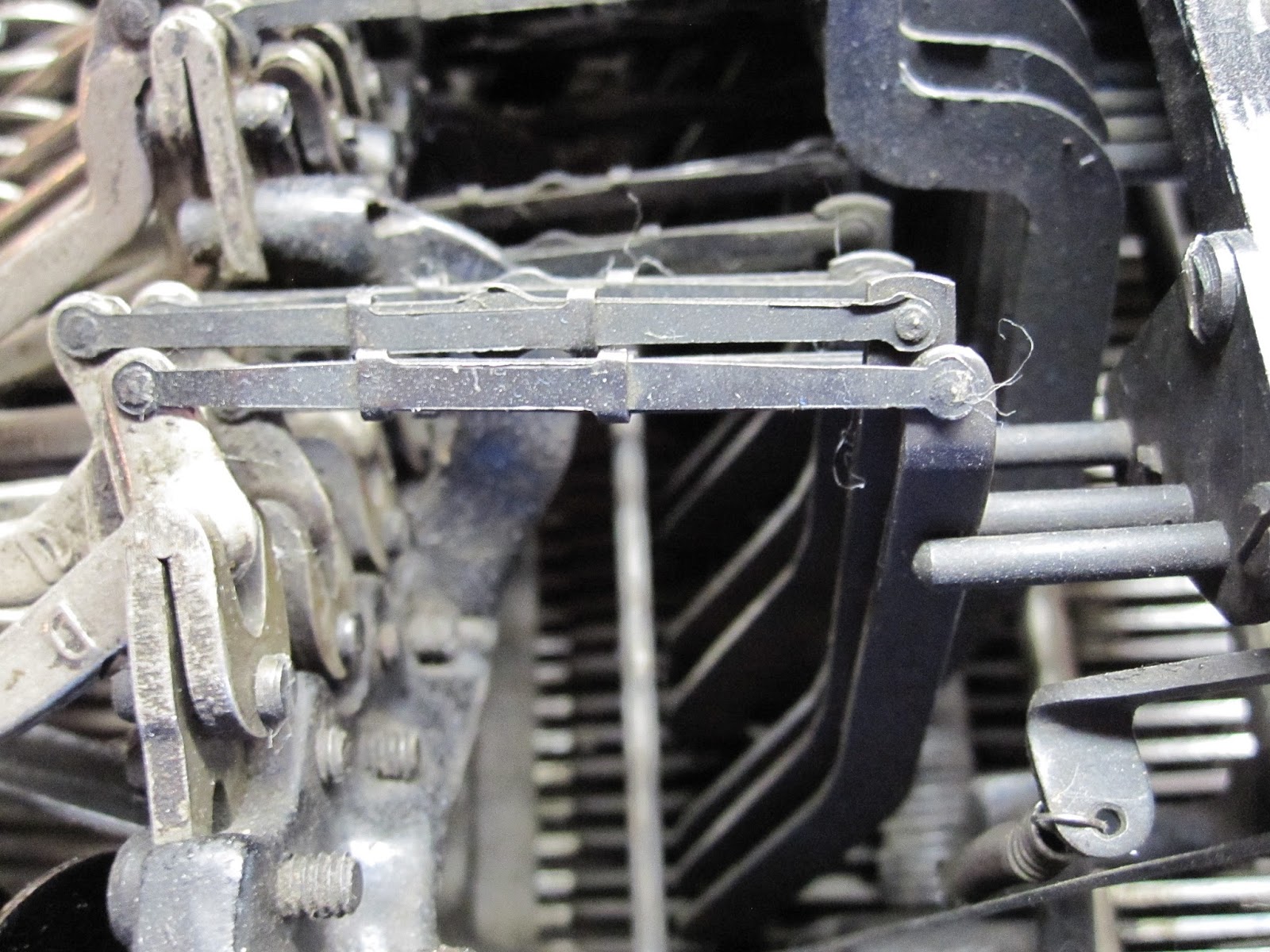
An expert was hired to
design the machine, however time passed without a design that would pass Mr.
Fox’s judgement, at which point he decided he would simply have to design the
machine himself. Spending enormous amounts of time studying and researching the
field, covering every patent that had ever been taken out on typewriters, and
conducting a long course of experiments, he created within a few months of hard
work the Fox Typewriter.
Soon after, the market
began to demand visible machines, but Mr. Fox chose to perfect his blind
typewriter first, stating that he would not produce an article which he could
not recommend for speed, accuracy, and durability. With the help of his son W.
H. Fox, and a few others, he tackled the problems faced by most other
typewriter designers. In less than twelve months, Mr. Fox and his helpers
solved the problems and built the first Fox “Visible” by hand at the cost of $1000.
Once complete, Fox subjected it to a merciless and thorough trial, which it
completed handedly.
Within 12 months of the
first visible machine being made, over two thousand special tools were made for
building it, and over $80,000 worth of finished typewriters were sold, a
business feat not previously equaled, all due to his high reputation which he
made with his “blind” machines.
As his company succeeded,
Fox still spent every day conducting interviews, writng an responding to correspondence,
making plans of promotion, working on machine designs, attending legal matters,
working on typewriter improvements, business promotions, and conducting general
management within the company.
Mr. Fox’s son, at this
time 25 years of age, was the superintendent of the works and a co-worker with
his father in invention and design. He had been given the choice by his father
between going to college, and going into the shops to learn the business, of
which he chose the latter.
Mr. Fox had made the Fox Typewriter
Company’s continuing goal to be the improvement of the quality of the product,
regardless of cost, and an effort to reduce the cost of manufacture without a
detriment to quality. Though paradoxical in essence, this was achieved to some
degree. By having employees scrutinize every last screw and spring, quality of
every machine was achieved, as no inferior product was allowed. And the
implementation of a special cost system of accounting allowed the cost of any
action or production to be reported to a manager within two hours, allowing for
any issues to be nearly immediately dealt with.
An employee of Mr. Fox had
this to say about the man in charge; “The greatest thing about Mr. Fox is his
unwavering hope, faith, courage, and cheerfulness in the face of the most
trying circumstances. No difficulty daunts him, and he always finds a way out.”
Source: The Business Philosopher, Volume 4, 1908.